The evolution of vitamin E
All living things are exposed to natural radiation and substances that occasionally break down molecules inside cells, which then act as aggressive "free radicals" and can cause a chain reaction of further destruction. The oxygen with which we breathe also ends up in such radicals. Nature has developed protection against this. We call it vitamin E. It consists of the (tocol) ring, which can intercept such dangerous fragments, and the "tail" (rest).
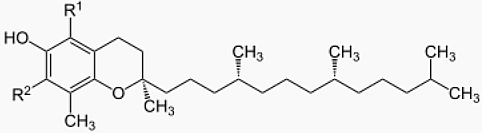
The simplest, slowest and heaviest form of vitamin E is alpha-tocopherol (a-T0). This is the preferred storage form of the vitamin. There are also seven other forms, all of which work faster and more intensely.
The functional group (the Tocol ring) is lightened by edge parts (methyl groups, R1, R2) - this is how the beta, gamma, delta versions were created. They are the better antioxidant, but do not make the simpler versions superfluous, as they each have an optimal effect on different cell components. We get alpha, beta, gamma, delta tocopherol.
Other versions have a more active “residue”, with 1 to 3 double bonds in residue. Tocomonoenole and MDT with 1 or 2 double bonds rarely occur. tocotrienols with three double bonds are the most active:
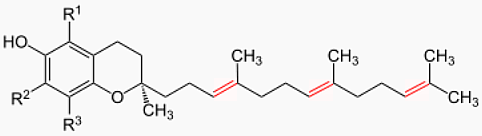
These double bonds create a much more mobile structure, similar to how polyunsaturated oils behave to saturated fats. Triunsaturated vitamin E, which are tocotrienols. They are available in four versions, alpha to delta.
The fatal mistake
Due to a fatal error in science, one has to say, research has for a long time only focused on the simplest molecule of the eight, the alpha-tocopherol (aT0). Because mammals, including humans, have a transport and storage mechanism that prefers to store and transport aT0. Economic interests also played a role. Alpha-tocopherol was chemically created, synthesized, mixed and used all rac alpha-tocopheryl acetate manufactured by the clay and distributed to people (in pills, capsules and processed foods).
This is disastrous for two reasons: Firstly, in higher concentrations, this alpha-tocopherol even has a pro-oxidative effect, i.e. exactly the opposite. Secondly, because alpha-tocopherol is the more active version of the vitamin E complexrepressed. Millions of people have deprived themselves of the other isomers by taking the chemical a-tocopherol. How could one assume that a diverse enzyme system that has existed for millions of years could be replaced by a basic chemical product?
Natural sources
Those who rely on natural sources are better off. In nature, vitamin E usually occurs as a mixture of tocopherols and tocotrienols. Come from some sourcestocotrienolsincreasingly. For example in grains (barley, rice), annatto seeds, grape seeds and palm fruits. They are now commercially enriched from vegetable oils and a variety of research studies have shown new amazing results through the use of tocotrienols.
General
A clear overview: tocotrienols
- are 40-60 times more effective as an antioxidant on the cell membranes than ordinary vitamin E (anti-aging, cell protection, cancer protection)
- have an anti-inflammatory effect
- work against arteriosclerosis and other heart/circulatory diseases; like statins, they can lower cholesterol levels.
- Starting from concentrations of 5umol, they cause apoptosis (death) of cancer cells.
- protect brain cells from neurodegeneration
So there is a natural product that has answers to the grand problems of today's medicine and pharmacology.
This website would like to inform a specialist audience about tocotrienols. Thanks to the Internet, there is now direct access to global research. This documentation is provided with references to the original publications of the relevant scientific studies.
The information on this website is designed to provide information to a specialist audience. Health topics are addressed. This information thennotthe self-diagnosis othe self-treatment and replacedkaTreatment by a doctor, specialist, alternative practitioner or pharmacist. If you have any health questions, please contact a doctor, pharmacist or alternative practitioner.