
Modulation of collagen synthesis and its gene expression in human skin fibroblasts by tocotrienol-rich fraction.
Tocotrienols provide collagen in the skin
At a conference we found out more from Dr. Sharon Ling (London, UK) about the studies she has carried out. The exciting result: tocotrienols (Tocomin) were able to significantly increase the content of pro-collagen (PICP) in the skin (from 40 to 100). She described these results as “very encouraging.”
Collagen is the protein that gives the skin stability and elasticity. Skin creams often contain collagen - which, however, has little influence on the collageninthe skin has. With the tocotrienolsn there is now a possibility of the actual production of Collagen in skin cells to increase(!). A study currently underway confirmed this even in the low concentration of 10ng/ml.
study structure. One part of the participants received tocotrienols (Tocomin), one part placebo. The test subjects were questioned about the following characteristics after 2 and 4 weeks of treatment with tocotrienolsn:
|
|
IneveryoneThese criteria rated the participants with tocotrienolsn their skin as significantly better, in contrast to the control group. The impact on spots/freckles and acne/pimples was rated particularly positive.
The accompanying examination by dermatologists also revealed particularly positive developments in the areas of skin smoothness, dark circles around the eyes, skin moisture and elasticity.
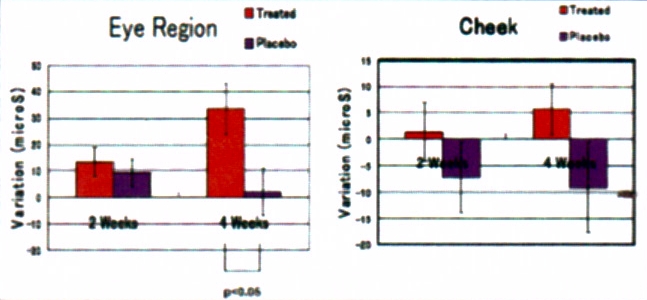
Improved skin moisture was found through tocotrienols, especially for the area around the eyes. After 4 weeks the assessment was again significantly better.
The graphic shows the development in the area around the eyes and cheeks.
The red bar (tocotrienol cream) gives the significantly better assessment compared to the purple bar (placebo) after 2 and 4 weeks.
Further studies:
Result: skin cells treated with tocotrienol (TRF) had a around 70% higher collagen production in comparison to the control group.